

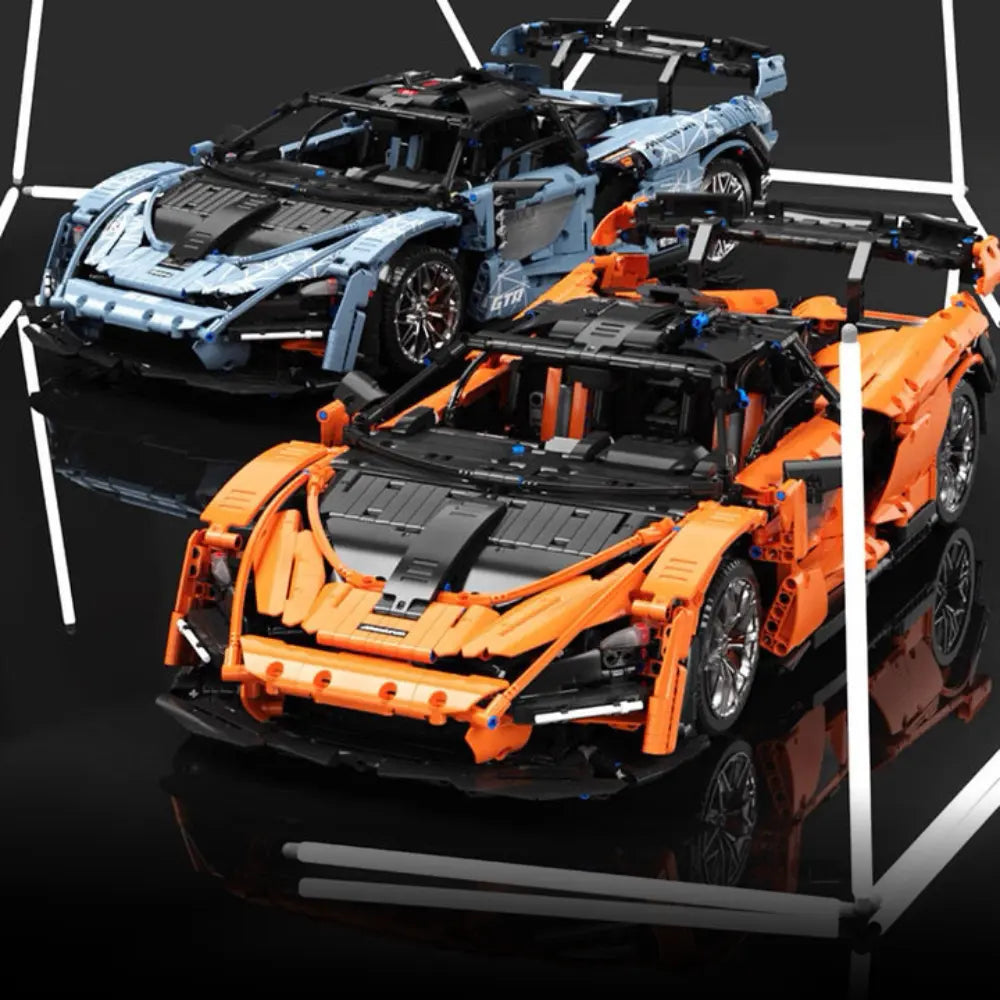
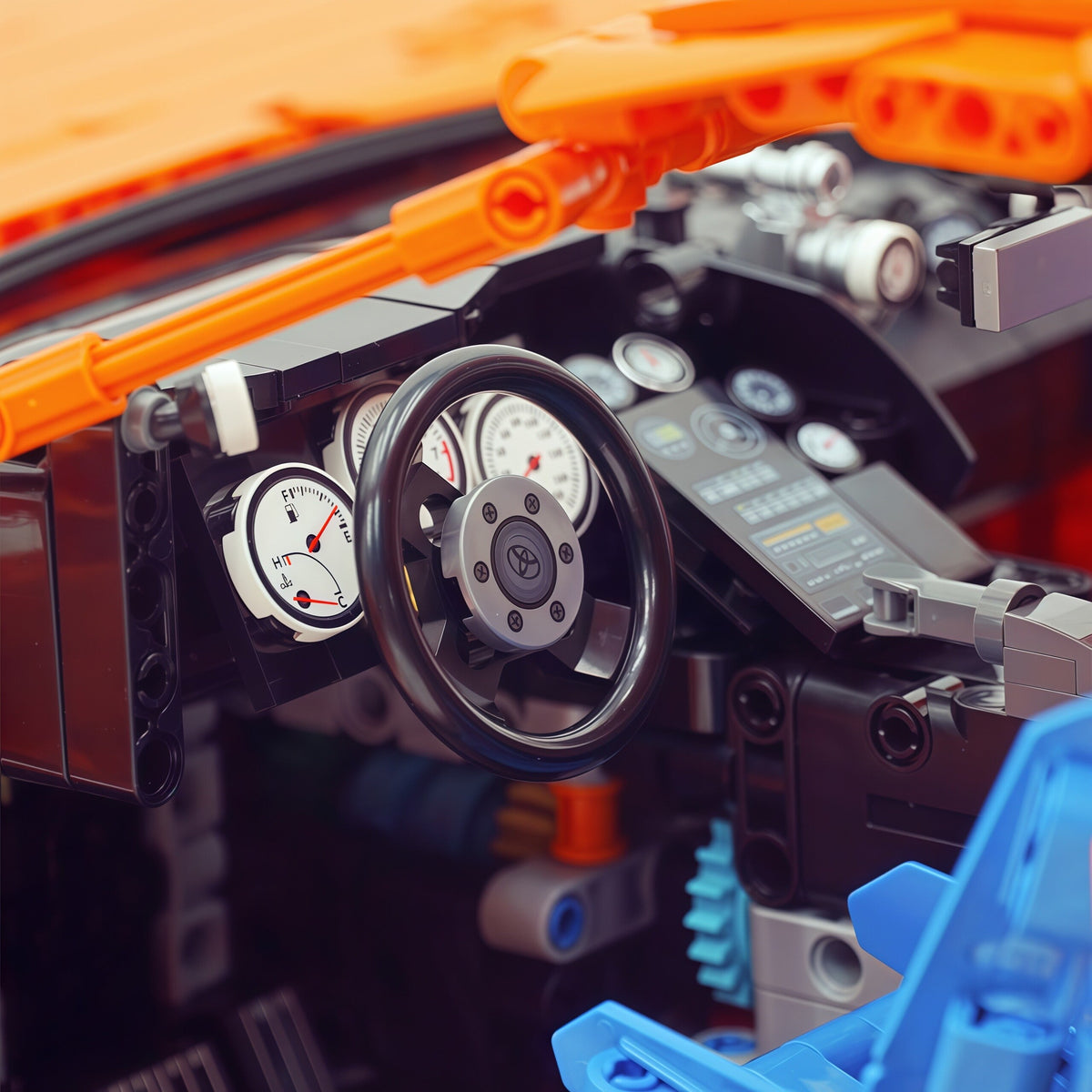
Steering and driving solve two different problems that happen to show up in the same corner. Driving is about getting power to the wheels. Steering is about pointing them. Get either one slightly wrong and a build that looks finished starts to feel wrong the moment it moves — vague, notchy, or pulling to one side. Both problems have well-understood engineering answers, and both translate directly into brick form.
Why turning a corner is harder than it looks
Picture a car going around a bend. The two front wheels aren’t just turning left or right by the same amount — they’re travelling along two different arcs. The inside wheel is tracing a tighter circle than the outside wheel, which means it needs to be angled more sharply to follow that tighter path without scrubbing sideways across the ground.
This is called Ackermann steering geometry, named after Rudolph Ackermann, who patented the idea in England in 1818 — though the actual concept came from Georg Lankensperger, a carriage builder in Munich, a year earlier. It was originally worked out to stop horse-drawn carriage wheels scrubbing and wearing unevenly on tight turns, and every steered vehicle since has had to solve the same basic problem.
The practical construction is simple once you see it: draw a line from each front wheel’s pivot point, through the point where its steering arm connects to the linkage, and extend that line backward. Done correctly, both lines meet at a single point — the centre of the rear axle. That’s the geometric signature of correct Ackermann geometry, and it’s genuinely checkable on a physical build, brick or otherwise.
This matters more for small-scale builds than you might expect. The amount of angle difference needed between the inner and outer wheel depends on the ratio between a vehicle’s track (the width between left and right wheels) and its wheelbase (the distance between front and rear axles). Short-wheelbase, wide-track vehicles — go-karts are the classic real-world example — need much more aggressive Ackermann correction than a long-wheelbase car. Most brick-built cars, especially at smaller scales, end up proportioned closer to a go-kart than a saloon car, which means getting this geometry right actually matters more for a MOC than it does for the full-size car it’s modelled on.
Driving has the mirror-image problem
Steering solves “the wheels need to point at different angles in a turn.” Driving solves the equivalent problem for power: the outside wheel travels further than the inside wheel through the same corner, in the same amount of time, which means it needs to spin faster. Connect both driven wheels rigidly to one solid axle and you’ve made that impossible — something has to scrub, skip, or fight the turn.
A differential solves it: a small cage of gears that lets both wheels receive power while allowing them to spin at different speeds. Straight-line driving, both wheels turn together as one unit. Cornering, the gears inside the differential’s cage start walking, feeding extra rotation to the outside wheel and taking it away from the inside one, automatically, with no electronics involved.
Whether your build needs one depends entirely on what it’s for. A car meant to corner cleanly at speed benefits from a differential. A drift-oriented build is often better without one — locking both rear wheels to a solid axle makes the rear end break traction as a single unit rather than one wheel gripping and pulling the car straight, which is exactly what a drift setup wants. (More on that in our Drift RC Car guide.)
Building the steering linkage: what actually goes wrong
Most steering problems in a finished build trace back to one of a small handful of causes, and they’re worth checking for specifically rather than guessing.
Servo mounting and horn alignment. The servo steering motor needs to be mounted rigidly, with its output horn centred correctly relative to the linkage. A servo that’s slightly off-centre when the steering is meant to be pointing straight ahead will never return to true centre — the car will subtly pull to one side even with no input at all.
Linkage length and slop. Every joint in a steering linkage — from the servo horn to the steering arm to the wheel knuckle — adds a small amount of play if it’s not tight. That play accumulates. A linkage with several loose connections in series can add up to noticeable free movement at the wheel, which shows up as vague, imprecise steering even when the servo itself is working correctly. Keep the linkage as short and direct as the build allows; fewer joints means less accumulated slop.
Endpoint mismatch. If the servo tries to travel further than the physical linkage geometry allows — because the steering arm hits a mechanical limit before the servo has finished its movement — something has to give, and it’s usually a stripped gear inside the servo or a bent linkage. Test the full range of motion by hand before powering it up, and confirm the mechanical limit is reached slightly before the servo’s own limit, not after.
Toe misalignment. If the wheels aren’t set perfectly parallel when centred, the car will pull to one side even with flawless Ackermann geometry and a perfectly centred servo. This one’s easy to miss because it looks like a steering fault when it’s actually a static alignment issue, fixable by adjusting the linkage length on one side until both wheels point straight ahead at rest.
A practical build order
- Confirm your Ackermann geometry on paper or in a build first. Check that lines from each pivot through the steering arm meet at a single point behind the axle, roughly at the centre of the rear axle line.
- Build the steering linkage as short and direct as possible. Fewer joints, less accumulated slop.
- Mount the servo rigidly and centre the horn before attaching the linkage. Get this right before anything downstream is connected.
- Test the full range of motion by hand before adding power. Confirm it moves smoothly lock to lock with no binding, and that the mechanical limit is reached before the servo’s own limit.
- Decide on a differential based on what the build is for, not by default — a differential for a build meant to corner cleanly, a solid axle for a build meant to drift.
- Set static toe last, once everything else is confirmed working, by adjusting linkage length until both wheels sit parallel at rest.
For the wider RC system — motors, receiver, wiring — see our How to Build a LEGO RC Car guide, and How Does LEGO Remote Control Work for what each component does.

Leave a comment
This site is protected by hCaptcha and the hCaptcha Privacy Policy and Terms of Service apply.