
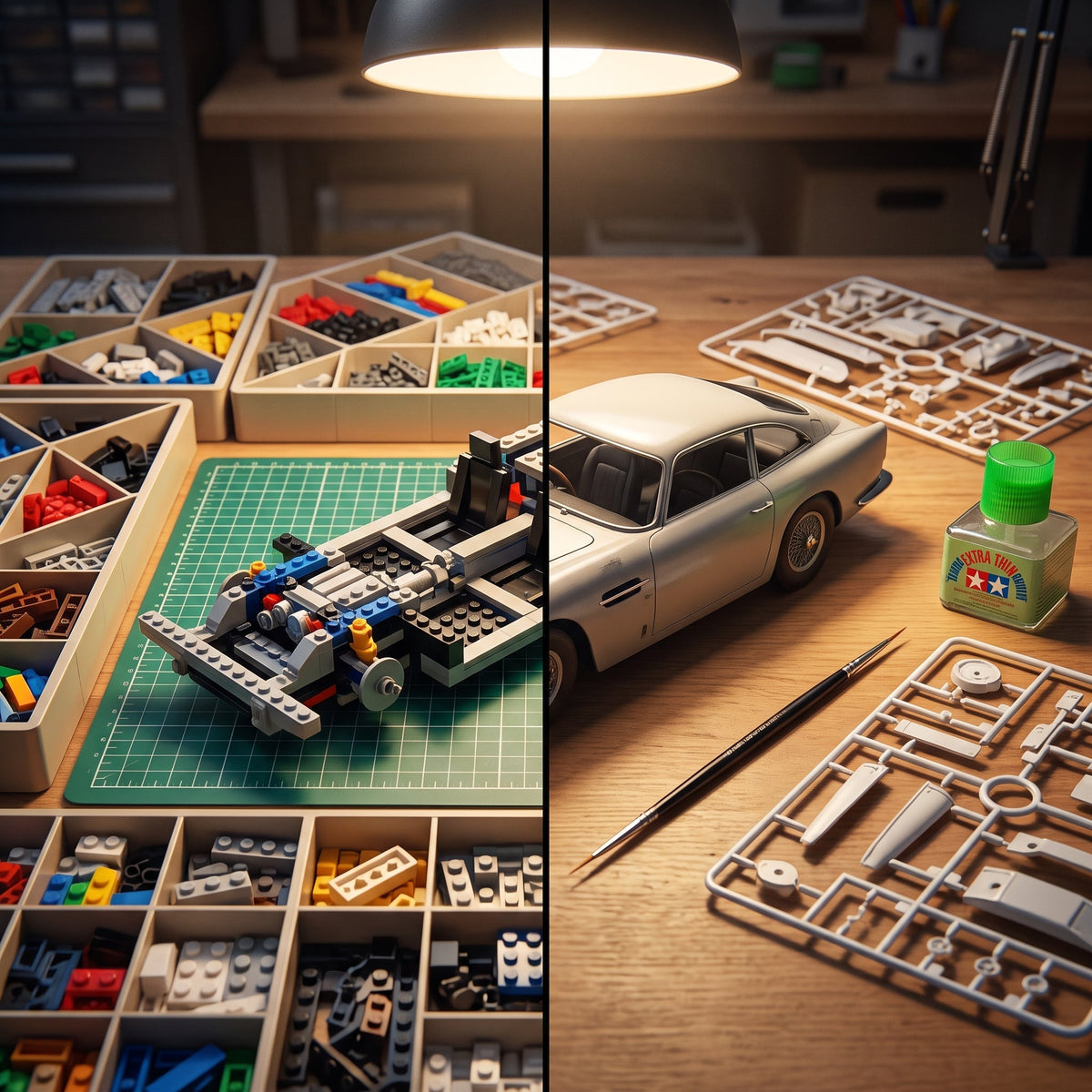
If you’ve built plastic scale model kits and you’re wondering whether brick-built MOC cars are a real alternative or just a novelty, the honest answer is: it depends what you’re actually after. Both are legitimate, established ways to build a scale model car — they just optimise for different things. Here’s an honest comparison, not a sales pitch.
The build process is genuinely different
Traditional plastic kits from brands like Tamiya, Revell and Airfix are rated on a five-level skill system. Level 1 kits snap together with no glue or paint needed — usually 10-30 pieces, aimed at beginners. From Level 2 upward, you’re typically working with plastic cement, sprue cutters, a hobby knife, sandpaper to clean up seams, and paint if you want a finished, realistic look rather than bare plastic. Level 5 kits can run several hundred pieces with genuinely fine detail and moving parts, and are built for experienced modellers.
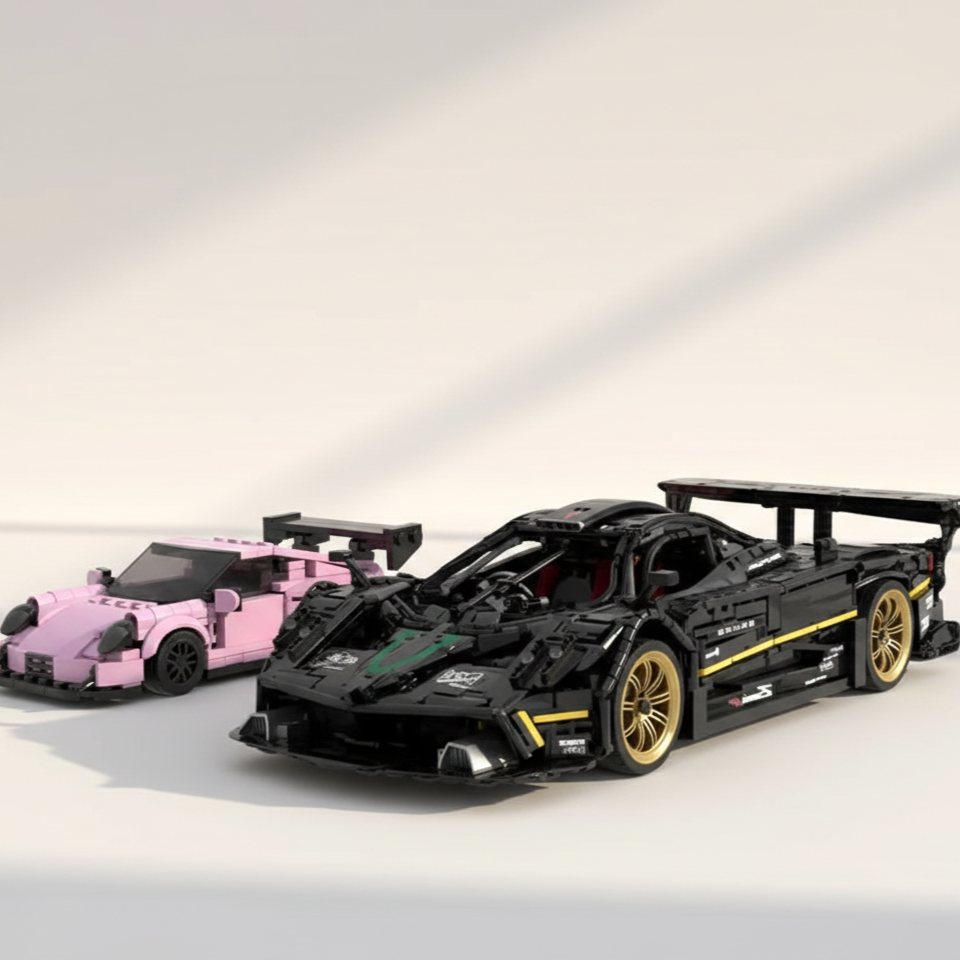
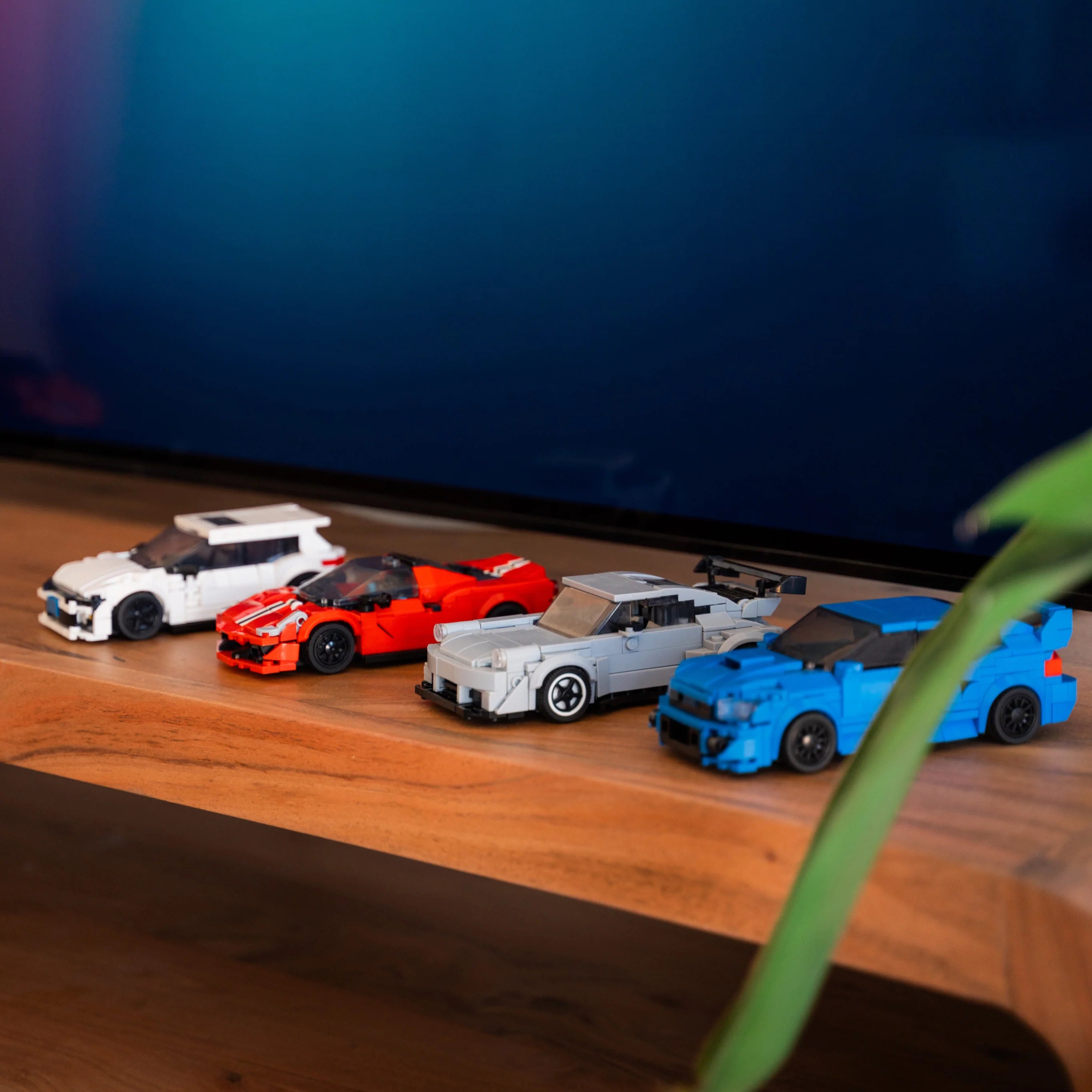
Brick-built MOC kits work differently by nature, not as a simplified “easy mode.” Every kit is snap-fit — no glue, no paint required, no solvents, no drying time between steps. That’s not unique to brick kits as a concept, either: Airfix themselves sell a “Quick Build” line that explicitly uses, in their words, “brick-building technology (similar to Lego)” specifically as the accessible, tool-free on-ramp into the hobby. The plastic modelling world already validated brick-based construction as the answer to “how do I remove the glue-and-paint barrier” — brick-built MOC kits just build an entire hobby around that idea rather than treating it as an entry-level product line.
Permanence: one is final, one isn’t
A glued and painted plastic kit is permanent. Once the cement sets, that’s the model — mistakes get sanded and repainted, not undone, and the finished piece can’t be taken apart and rebuilt into something else.
A brick-built kit can be disassembled and rebuilt. That matters more than it might sound: it means a mistake mid-build is a five-minute fix, not a solvent-and-sandpaper one, and it means the same set of pieces has a life beyond the first build if you ever want to reconfigure or rebuild it.
Function: static display vs. built-in mechanics
Most plastic kits, once assembled, are static — display pieces rather than toys, and gluing typically rules out later motorisation even if you wanted to add it. There are exceptions built specifically for play (Revell’s “Build ‘N Play” range, for instance, is designed to survive being rolled around and can be taken apart and rebuilt), but they’re a specific product line, not the default.
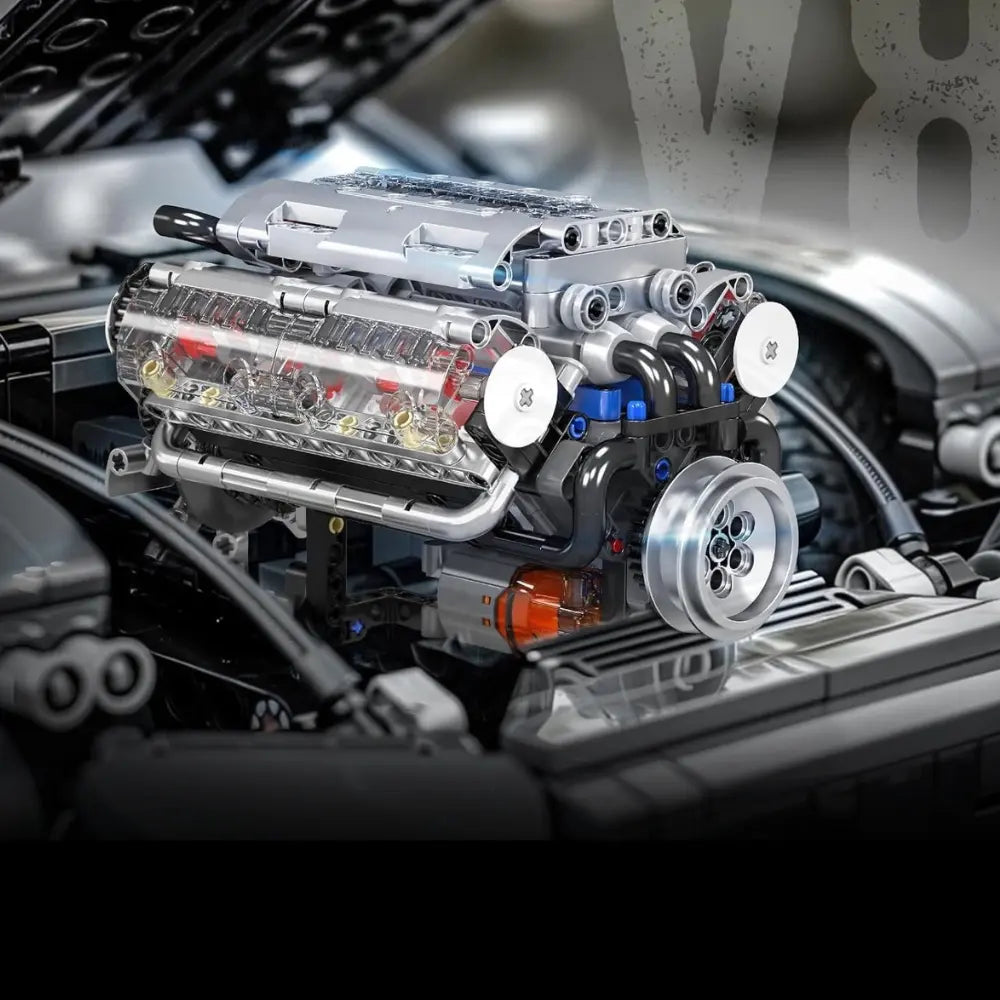
Remote control and mechanical function are the default at the larger end of brick-built kits, not an add-on. Working steering, opening doors, sometimes suspension — these come standard on most 1:8 and 1:10 builds rather than requiring a separate RC conversion kit or electronics know-how.
Cost is scale-dependent, not a flat answer
This is where a fair comparison has to get specific, because the honest picture changes depending on what you’re comparing.
At the small, static-display end, plastic wins on price clearly: a quality 1:24 Tamiya kit typically runs £15-25. A comparable static brick-built model at a similar scale costs more.
At the RC-capable end, the picture flips to roughly comparable: Tamiya’s RC-capable kits commonly run £150-500+, which is in the same range as large-format brick-built kits with remote control and functional features built in. At this tier, you’re not really choosing based on price — you’re choosing based on build process and whether you want to paint and glue or snap together.
What each one actually rewards
Plastic kits, built and painted well, can achieve a level of paint-based realism — weathering, panel shading, authentic factory colour matching — that’s hard to replicate any other way. That’s the reward for the extra tools, time and skill investment: a genuinely high ceiling for builders who enjoy the painting and finishing side of the hobby as much as the assembly.
Brick-built kits reward a different set of things: faster, cleaner assembly without a workspace full of solvents and paint; the option to rebuild or reconfigure later; and, at the larger scales, real mechanical function as standard rather than an advanced add-on.
So which should you build?
If you enjoy painting and finishing as much as assembly, want the highest possible paint-realism ceiling, and don’t mind glue and solvents, traditional plastic kits still do that better than anything else. If you want a clean, tool-free build, the option to take it apart and rebuild it, and remote control or mechanical function without a separate electronics project, a brick-built kit is the more direct route to that outcome. Plenty of builders end up doing both — they’re not mutually exclusive hobbies, just different tools for different outcomes.
If you’re leaning toward giving brick-built a try, our scale guide is a good starting point for figuring out which size fits what you want to build.

Leave a comment
This site is protected by hCaptcha and the hCaptcha Privacy Policy and Terms of Service apply.