
Some cars are famous for what they do. Screen cars are famous for what they mean, and that's a different kind of famous entirely. Nobody remembers the Ecto-1's engine output. Everybody remembers the siren.
This corner of our catalogue exists because these are the cars people email us about, ask for, and photograph most enthusiastically once built. Before we walk through them, the necessary sentence, said plainly: these kits are fan interpretations of iconic screen vehicles, built from compatible bricks. They are not official licensed merchandise of any film, series or studio, and we're not affiliated with any of them. What you're buying is the design work: the puzzle of getting a legend's silhouette right in brick form.
And some of these silhouettes are proper puzzles. That's half the fun.
The Ecto-1: the hardest shape on this list
Start with the big one. The Ghostbusters Ecto-1, a 1959 Cadillac Miller-Meteor ambulance conversion, which is a sentence that already tells you why no mainstream toy line was ever going to make it and why everyone wants it anyway.
As a brick design challenge, it's brutal in the best way. Late-fifties Cadillac means tailfins, and tailfins mean long tapering curves that bricks fundamentally don't want to make. Then the roof: that gloriously overloaded equipment rack, all tanks and ladders and aerials, which has to read as chaotic while being structurally solid enough to survive dusting. Get the Ecto-1 right and you've solved two opposite problems on one car, elegance below, clutter above. It's the kit our designers argued over most, and it shows.
KITT: how do you build a character?
The Knight Rider car is a strange design brief, because the car itself is, whisper it, a fairly plain black eighties coupe. The fame lives almost entirely in one detail: the red scanner light sweeping across the nose.
Which makes it a fascinating brick problem. The whole build is in service of proportions, the long low bonnet, the blunt tail, and then absolutely nailing that front end, because the front end is the character. A KITT model with the nose slightly wrong is just a black car. A KITT model with the nose right needs no explanation to anyone who grew up within reach of a television. Minimalism is harder than it looks, in bricks as everywhere else.
The Interceptor: menace, supercharged
The Mad Max V8 Interceptor, the Pursuit Special, might be the most attitude per brick on this list. An Australian Ford Falcon coupe turned apocalyptic, and every modification on it exists to make the car look like a threat.
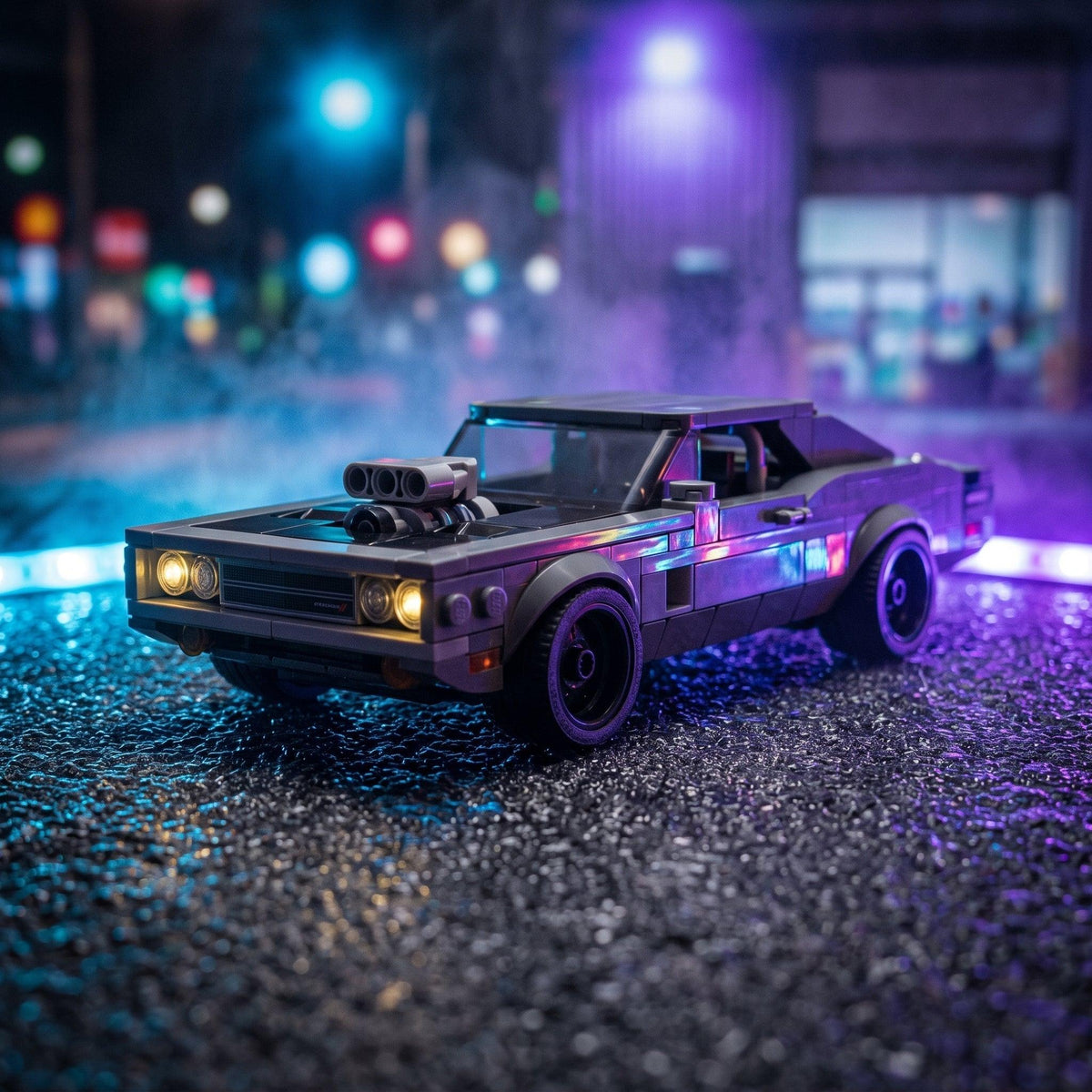
The brick challenges are specific and juicy: the supercharger erupting through the bonnet, which has to look mechanical rather than decorative, the side pipes running down the flanks, the black-on-black bodywork that means the whole model reads through shape and shadow rather than colour. Under display lighting, done properly, it looms. That's the word. Looms.
The A-Team van: a masterclass in a stripe
Now for the vans, and the GMC Vandura from the A-Team proves you don't need curves to be iconic. A box on wheels, black and grey, one red stripe, a rooftop spoiler. That's it. That's one of the most recognisable vehicles in television history.
Simple shapes are honest shapes, and honesty is unforgiving: with no dramatic curves to distract the eye, everything hangs on getting the stripe line exactly right and the proportions of the box dead-on. A centimetre of error a curvy supercar would swallow whole is glaring on a van. Builders love this one because it comes together satisfyingly fast, looks unmistakable from across a room, and pairs beautifully on a shelf with something exotic. Contrast is a display strategy.
The other GMC: time travel's support vehicle
Deeper cut, this one, and we love it precisely for that. The GMC Value Van from Back to the Future, the boxy workhorse from the franchise everyone remembers for a very different vehicle.
That's exactly its charm. Anyone can display the hero car of a franchise. Displaying the van is a wink to the people who really know the films, and this hobby is full of people who really know the films. As a build, it shares the A-Team van's virtues, honest boxy geometry, quick satisfying assembly, with the added pleasure of being a conversation piece that starts conversations only with the right people.
Mr. Bean's MINI: comedy in lime green
The 1977 Leyland Cars MINI 1000 Mark IV, in that unmistakable lime green with the matte black bonnet, and if you know, you already smiled.
Physical comedy needs a straight man, and for years the straight man was this car. The brick challenge is charm at small scale: a MINI is tiny, so the model has to capture the stance, the colour split and the cheerful roundedness without much room to work in. It's also, being an ordinary little British car, the most quietly patriotic thing on this list. The armchair on the roof, sadly, you'll have to build yourself.
The Johnny English Phantom: villainy, but British
Rounding out the very British end of the shelf, Johnny English's V16 Rolls Royce Phantom. A spy spoof deserves a spy car played completely straight, and a Phantom with a V16 under it is exactly that joke, delivered deadpan.
In brick form it's all about mass and dignity: the huge upright grille, the long bonnet that needs to feel like it goes on slightly too long, the formal proportions that make everything else on your shelf look like it's trying too hard. Park it next to the Interceptor and you've got the two poles of automotive character covered, feral and butler. The V16 story behind the real car is stranger than the film's gadgets — we've written up the full story separately if you want the details.
Why we keep designing these
The screen cars are the kits where community demand leads and we follow. People don't ask us for "a sixties ambulance". They ask for the Ecto-1, by name, with feeling, usually with a story attached about who they watched the film with. That emotional pull is also why these builds get finished, photographed and shared more than almost anything else we make.
And from the design side, they're the deep end. Real production cars have factory drawings and rational shapes. Screen cars have modifications bolted on by prop departments for drama, which makes them gloriously irrational objects to engineer in brick. Every one on this list taught our team something a sensible car never would have.
Pick the one attached to your story. There's always one. That's rather the point of them.

Leave a comment
This site is protected by hCaptcha and the hCaptcha Privacy Policy and Terms of Service apply.