
Nobody can tell you exactly how long your build will take, and anyone quoting you a precise figure is guessing. What we can give you is ranges, honest ones, and more usefully, the short list of things that decide which end of the range you'll land on.
Here's what decides it.
The ranges, by piece count
Up to about 1,500 pieces: one long evening, maybe two short ones. Kits at this size are the closest thing to predictable. The build is mostly bodywork, the stages repeat, and there's nothing to test along the way. A relaxed first-timer might stretch it across two sittings. Someone on their fifth kit will finish with the evening to spare.
2,000 to 3,000 pieces: a weekend. Not a weekend of solid building, a weekend of sessions. The extra pieces bring opening doors, interiors, sometimes manual steering, and each of those slows the pace beyond what raw piece count suggests. A door hinge is ten pieces and fifteen minutes. A wing panel is ten pieces and ninety seconds. Same count, very different clock.
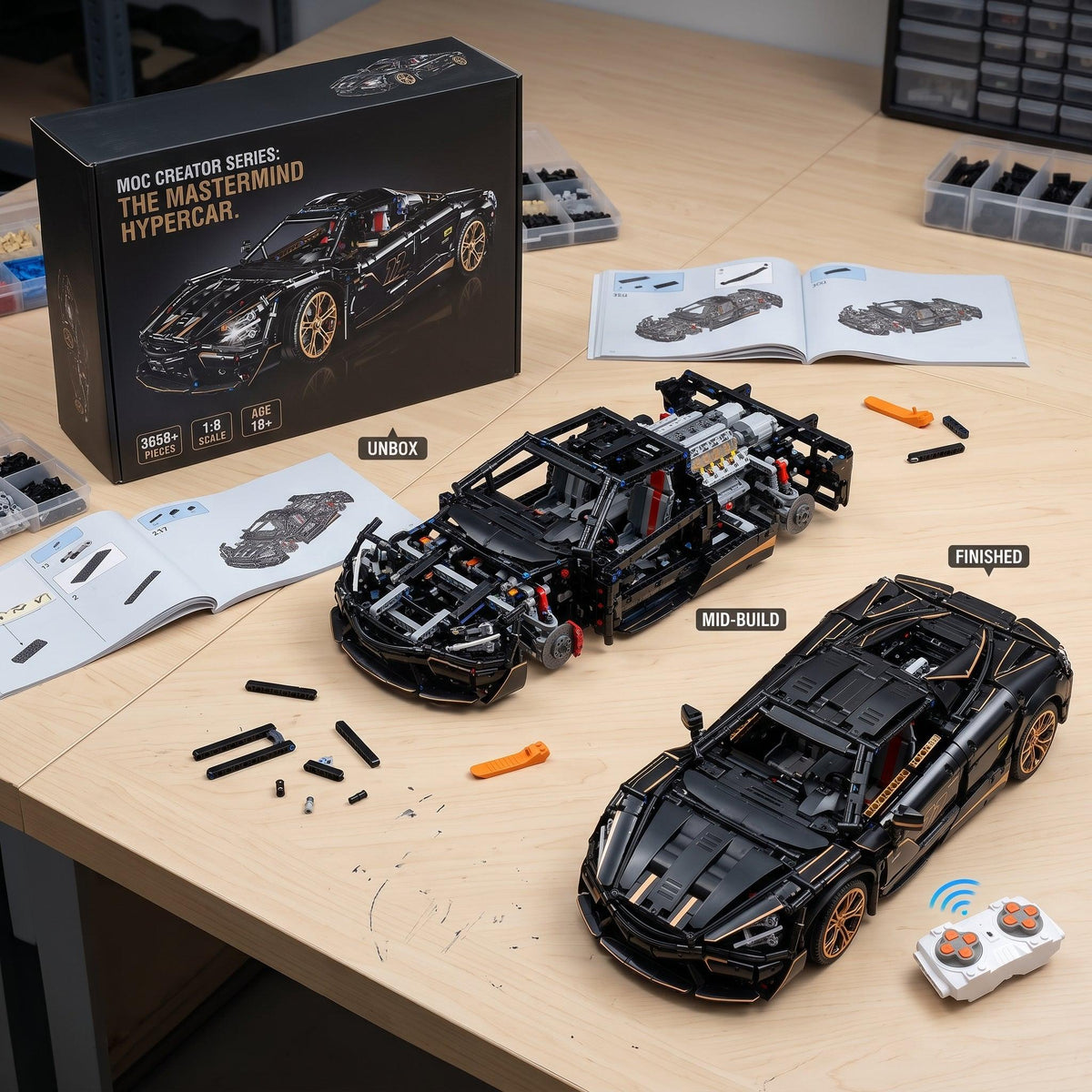
4,000 pieces and up, especially with RC: several evenings across a week or two, minimum. The big-scale kits are slower per piece than anything else you'll build, and the electronics are why. Motors need mounting, cables need routing at the exact step the instructions say, and every mechanism deserves a test before it disappears under bodywork. Something like our Lamborghini Aventador with the full RC package isn't a build you power through. It's a project you visit.
Treat all three ranges as midpoints, not promises. The factors below swing them, sometimes by half.
What actually decides your speed
Experience, but not the way people think. A fifth kit doesn't go faster because your fingers got quicker. It goes faster because you stop making the errors that cost time in blocks: the misread step you discover thirty steps later, the piece pressed in half-seated that gives the chassis a lean. Beginners don't build slowly. They un-build slowly.
Whether there's electronics inside. An RC kit of the same piece count as a static one takes meaningfully longer, full stop. Partly the extra assemblies, mostly the discipline they demand. Wiring can't be rushed, gear meshing can't be eyeballed, and the testing (more on that below) adds honest minutes to every mechanical stage. Those minutes are the best investment in the whole build, but they're on the clock.
Sessions versus one push. Counterintuitive one: building across several shorter sittings is usually faster in total hours than one heroic push. Fatigue is where mistakes come from, and mistakes are where the time goes. The step you fumble at 1 a.m. takes five minutes to build and twenty-five to fix. Stop while you're still sharp, and the total comes down.
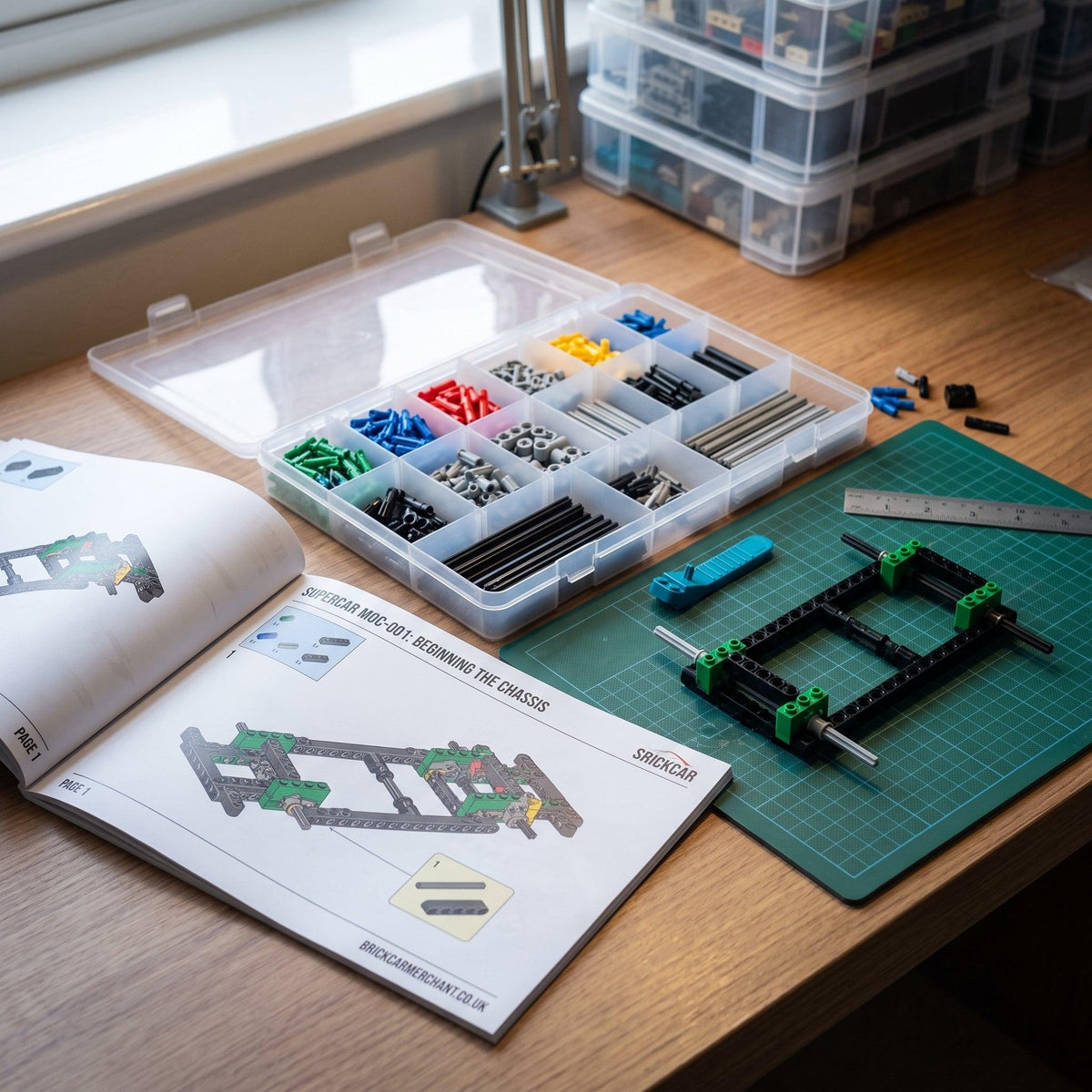
Setup you can't skip, only postpone. Sorting pieces before you start eats twenty to forty minutes upfront and repays it several times over. Skip it and the sorting still happens, just piecewise, mid-build, as hunting. Builds that start with tidy trays finish sooner. Every time.
The one habit that protects a big build
If you take a single thing from this article, take this: test every moving part the moment its assembly is complete. Not at the end. The moment it exists.
Built the steering rack? Turn it lock to lock, now, while it's exposed and fixable in two minutes. Assembled a door hinge? Open and close it a few times before the surrounding panels box it in. Finished the drivetrain? Spin the wheels and listen. A rough gear sounds rough immediately.
The maths of this is brutal in the wrong direction if you skip it. A fault found at assembly costs minutes. The same fault found after the bodywork is sealed costs an evening of careful disassembly, and worse, you now have to find it first, working blind through layers of finished car. Treat it as a rule, checkpoint by checkpoint. Plenty of builders learn the alternative the slow way.
Static builds get a gentler version of the same rule: press runs of bricks fully home as you go, and sight along the body lines at the end of each section. A lean caught early is one piece. A lean caught late is a search party.
So how long for you, honestly
Take the range for your kit's size. Then adjust with three questions.
First kit? Sit at the slow end and add a bit, and be completely fine with that. Speed was never the point of a first build.
Electronics inside? Slow end again, plus the testing minutes, which you're doing because you read the previous section.
Building in calm sessions rather than one tired marathon? Now you can trust the faster end.
And then, genuinely, stop watching the clock. The evenings are the hobby. The finished car is just the receipt.

Leave a comment
This site is protected by hCaptcha and the hCaptcha Privacy Policy and Terms of Service apply.