







There's a moment in every builder's life when the bodywork stops being the point. You've built the pretty cars. And then one day you find yourself turning a finished model over, watching the axles, and wondering how the thing underneath actually works. Welcome. This article is for you, and so is our Engines & Gearboxes collection, which exists for exactly this moment.
The mechanical side of brick building is a genuine miniature of real automotive engineering, not a gesture at it. The same problems, the same solutions, shrunk. Let's take the three headline mechanisms apart, in words, and see what each one is actually doing. (If you haven't picked a layout yet, our guide to V8, V12, W16 and the rest covers that side of the decision.)
The differential: the cleverest thing on the axle
Start with the mechanism that sounds the most boring and is secretly the most elegant.
Here's the problem it solves. When a car corners, the outer wheels travel a longer path than the inner ones. Longer path in the same time means the outer wheel must spin faster. Connect both wheels to one rigid axle and you've made that impossible: something has to skip, hop or scrub through every corner. Real cars solved this in the nineteenth century. Brick cars solve it the identical way.
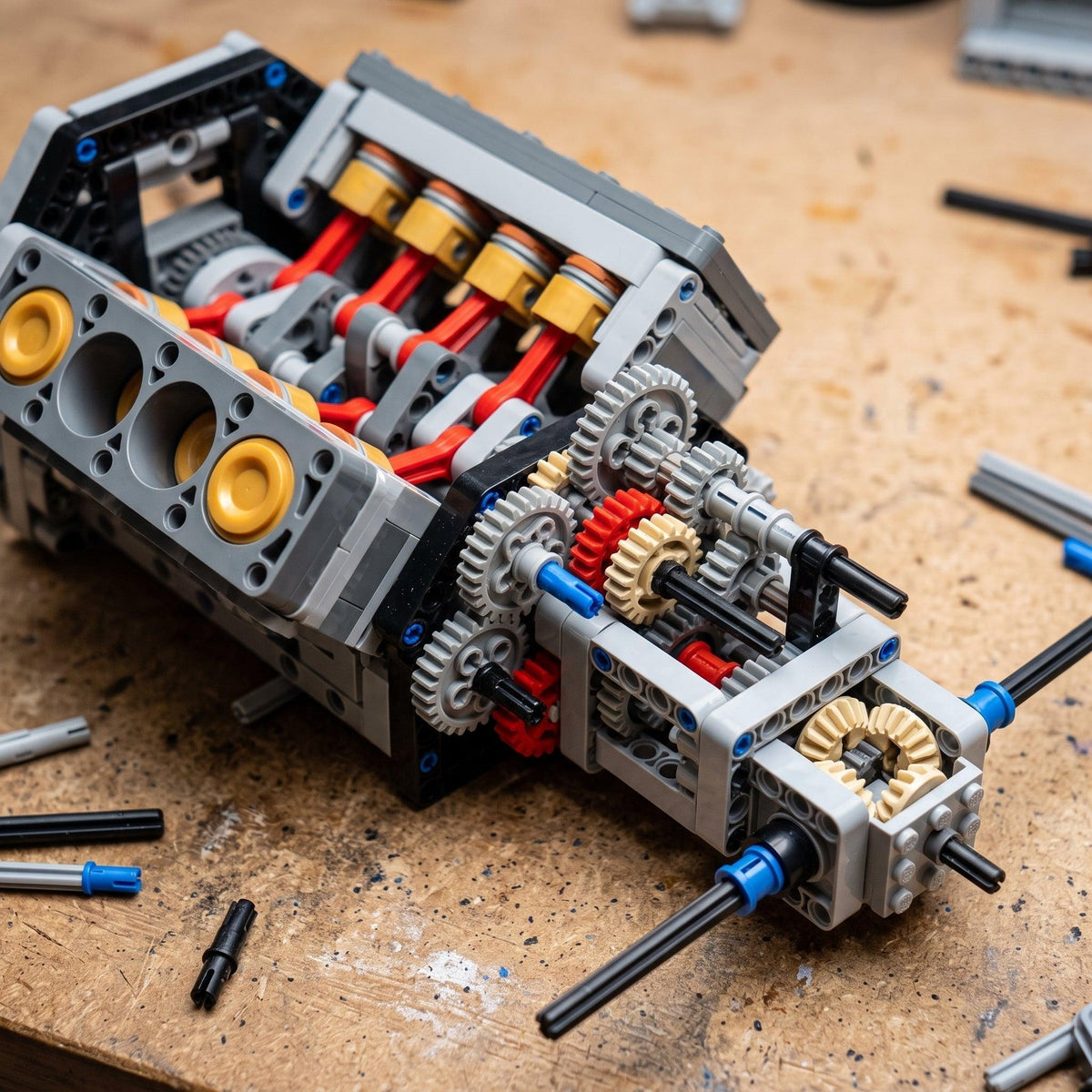
A brick differential is a small cage of gears sitting in the middle of the axle. Power comes in through a crown gear on the outside of the cage, so the whole cage turns. Inside, small bevel gears link the two half-axles, one to each rear wheel, through the cage rather than to each other directly. Driving straight, the inner gears don't rotate relative to the cage at all: the whole assembly turns as one lump and both wheels get equal drive. The moment the car corners, the inner gears start walking, feeding extra rotation to the outer wheel and subtracting it from the inner one. Automatically. No sensors, no control, just geometry balancing itself.
The lovely part: you can watch this happen on a brick model in a way you never can on a real car. Hold the finished axle, turn one wheel, and watch the other spin obligingly backwards through the cage. That little demonstration is the whole principle in your hands, and it's the moment these kits tend to convert people.
The gearbox: choosing your ratio
A gearbox answers a different question: not how wheels share speed, but how much speed you trade for how much force.
Mesh a small gear against a big one and you've made a choice. Drive the small one, and the big one turns slower but with more torque. Drive the big one, and the small one spins fast and weak. Every pairing of gear sizes is a different exchange rate between speed and effort, which is all a "gear ratio" is.
A working brick gearbox holds several of these pairings side by side on parallel shafts, all meshed, all turning whenever the input turns. The trick is that only one pairing at a time is actually connected through to the output. That selection is done by a sliding element on the output shaft, moved by the gear lever, which locks onto one gear's pairing or its neighbour's. Move the lever, the slider disengages one ratio and engages the next, and the output speed changes while the input carries on as before. First gear, second gear. Same principle as the H-pattern in a real manual, executed in studs and axles.
Building one is the single best mechanical education this hobby offers, and it's also where you need to be properly fussy, because a gearbox is unforgiving of sloppiness in a way bodywork never is. A gear meshed one half-stud off doesn't look wrong. It feels wrong: notchy, grinding, stiff. So shift it through every gear before you close it up, and if anything catches, go back now. There's no cosmetic rescue for a bad gearbox.
The engine: the difference between a model of an engine and a model that engines
Now the charmer of the trio, and the place where a real distinction hides.
Plenty of kits include an engine block: a nicely shaped lump under the bonnet with cylinder detailing and maybe some plumbing. That's sculpture. Good sculpture, often, and it photographs beautifully with the bonnet up. But it's a picture of an engine.
A working brick engine is a different creature. Under the cylinder detailing sits a genuine crankshaft, a real rotating shaft with offset throws, and on each throw rides a piston that slides up and down inside its cylinder as the shaft turns. Geared to the drivetrain, the whole thing runs whenever the wheels do: push the model along a table and the pistons pump in sequence, a tiny mechanical heartbeat you can see through the engine bay. Nothing combusts, obviously. The wheels drive the engine rather than the other way round. But the kinematics, crank, con-rods, reciprocating pistons, are the real thing in miniature, and a V-configuration with its two banks rising and falling in alternation is honestly a bit hypnotic.
So when you're reading a product page, that's the question to ask: does the engine move? The answer separates a detail feature from a mechanical one, and it's a fair chunk of the difference in build complexity too. A working engine wants precise alignment and free-spinning joints, one over-tightened connection and the pistons bind, which is exactly the sort of thing to test the moment the assembly is finished, while it's still exposed and fixable in a minute.
Where all this mechanical density lives
Follow the piece counts and you'll notice the pattern: the serious mechanisms cluster in the big scales. Not by accident. A working V8 with a gearbox behind it and a differential behind that simply needs physical volume, room for the shafts to run, the gears to mesh, the pistons to travel. At 1:24 there's barely space for the idea of it. At 1:8 there's an engine bay to fill, and these kits fill it with function rather than filler. Something like a large-scale kit with a detailed drivetrain is where you'll see the full chain in one build: engine turning, gearbox selecting, differential dividing, all the way to the road.
And that’s the point of the whole Engines & Gearboxes range: if a mechanism is in the kit, it’s there to work, not just to look the part. A gear lever that moves nothing, a differential-shaped lump that's rigid inside, that's set dressing, and set dressing under the bodywork is a strange thing to spend pieces on. The mechanical builds cost more attention than the shelf beauties, no argument. They repay it every time you flip the model over and turn a wheel.
Which, be warned, you will do constantly. Everyone does. It never quite stops being satisfying.

Leave a comment
This site is protected by hCaptcha and the hCaptcha Privacy Policy and Terms of Service apply.